Eurasia as Plan B
From Astana, Moscow presents the Eurasian Economic Union as a zone of commercial stability, as trade with Europe remains durably reduced.
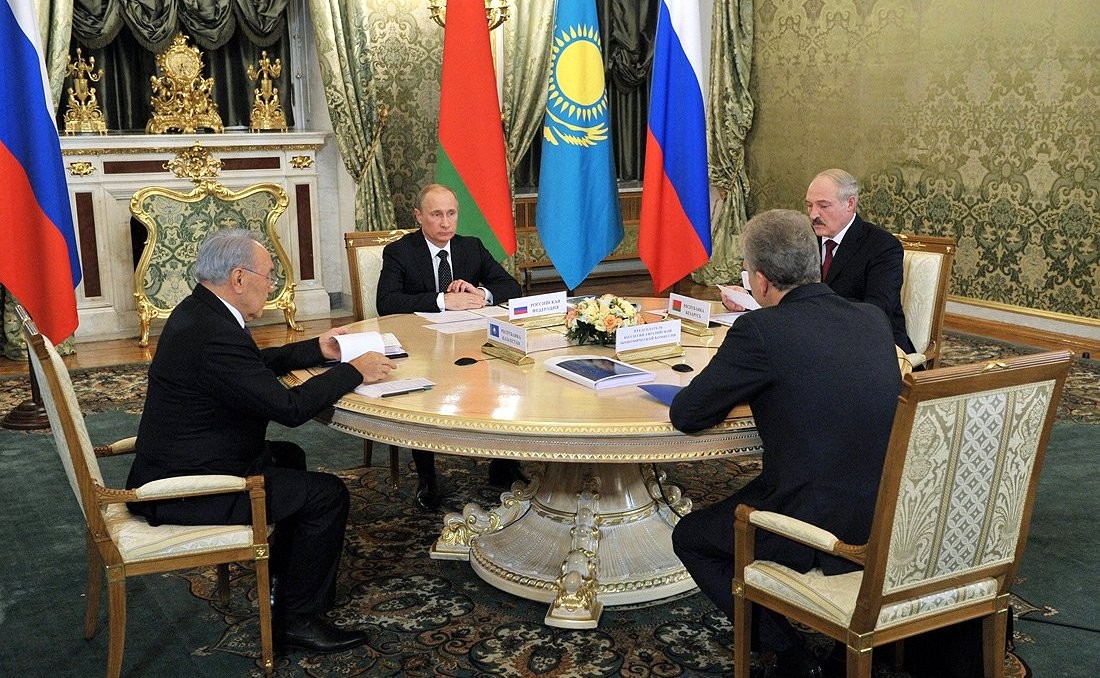
In Astana, delegations from Russia, Kazakhstan, Belarus, Armenia and Kyrgyzstan discuss tariffs, corridors, currencies and free-trade agreements as Western sanctions continue to redraw commercial routes. Behind the institutional communiqués, the question is straightforward: whether the EEU can become something other than a regional market dominated by Russia. A closer look at the data reveals a more nuanced picture: Moscow is indeed building Eurasian depth, but this alternative still depends heavily on China, India, hydrocarbons and indirect trade routes.
A union seeking to outgrow its format
In Astana on 29 May 2026, the setting matters as much as the speeches. Kazakhstan's capital hosts the Supreme Eurasian Economic Council in a sequence where Moscow seeks to embed the Eurasian Economic Union within a trajectory broader than the post-Soviet space alone. Vladimir Putin affirms that the EEU is functioning "broadly successfully" and that negotiations on trade liberalisation with India have intensified, according to Russian readouts of the summit. The framing is deliberate: it presents the EEU not merely as a regional integration instrument, but as a bridge towards Asia, the Gulf and the Global South.
The EEU remains, however, a medium-sized construction. It brings together five states — Russia, Belarus, Kazakhstan, Armenia and Kyrgyzstan — around a common market in goods, services, capital and labour. Its economic centre of gravity remains Russian, but its strategic usefulness has changed since 2022. Before the mass of Western sanctions, the EEU could appear to be an incomplete regional integration project. Since then, it has also served as a zone of absorption, redirection and normalisation of commercial flows.
The most telling figure comes from the Eurasian Economic Commission: mutual trade within the EEU reached $95.1 billion in 2025, with 5.9% growth in the fourth quarter, according to Interfax citing Union data. Member states anticipate a 6.3% rise in 2026. This is not the equivalent of the European market Russia has lost; it is, however, a regional base that helps absorb disruptions, coordinate standards and maintain nearby supply chains.
There lies the first limit of the official narrative. The EEU does not replace the European Union in volume, purchasing power or technological depth. Eurostat estimates that EU exports to Russia fell by 61% and European imports from Russia by 90% between the first quarter of 2022 and the fourth quarter of 2025. This collapse closed off a portion of direct flows, particularly in machinery, industrial equipment and dual-use goods.
But Russia's objective is no longer to reconstruct its economic relationship with Europe as it was. The goal is to substitute a more fragmented system for the old Euro-Russian link: intra-EEU trade, free-trade agreements with non-Western states, payments in national currencies, and logistics corridors towards the Gulf, Iran, India and China. This strategy does not eliminate the constraints; it displaces them.
Asia as commercial depth
In EEU corridors, the names that recur most are no longer Berlin, Paris or Milan, but New Delhi, Tehran, Jakarta, Abu Dhabi and Ulaanbaatar. The Eurasian Economic Commission reports that in 2025 the Union signed trade agreements with Indonesia, the United Arab Emirates and Mongolia, while the comprehensive free-trade agreement with Iran entered into force on 15 May 2025. Negotiations with India were intensified according to the Astana summit readout.
The deal with Iran is central to this new map. It is not merely about cutting tariffs. It links two economies under heavy Western restrictions and provides a commercial framework for flows already growing. Reuters reported in May 2025 that the agreement reduced average duties on Russian goods exported to Iran from 16.7% to 5.2%, with a potential gain of around $300 million per year for Russian exporters. Sectors mentioned include metals, grains, oils, paper and certain equipment.
The agreement with Indonesia extends the perimeter further. Signed in December 2025, it opens preferential access to approximately 90% of tariff lines, according to the Eurasian Economic Commission. Trade between Indonesia and the EEU reached $4.4 billion in 2025, with Indonesian exports dominated by palm oil, coffee, cocoa and seafood, while the EEU exports mainly coal, potash fertilisers, wheat and ferroalloys.
"Our arrangements show how the five Eurasian states and Indonesia are seeking deeper integration in regional and global value chains."
Bakytzhan Sagintayev, President of the Board of the Eurasian Economic Commission · December 2025India represents another dimension. It is not only a trade partner; it is a major energy buyer, a significant pharmaceutical actor and a potential supplier of machinery and engineering goods. At the Russia-India summit of December 2025, Moscow and New Delhi announced an objective of raising bilateral trade to $100 billion per year by 2030, from $68.7 billion in the preceding fiscal year, according to AP.
This shift should not be mistaken for a cost-free pivot. Russia-India trade remains heavily imbalanced: India buys large volumes of Russian hydrocarbons but seeks to expand its own exports to reduce its bilateral deficit. China remains the heaviest case: it has replaced Europe as Russia's main trading partner, but the relationship is asymmetric. Reuters reported that in 2025, Sino-Russian trade declined for the first time in five years, to around $234 billion, a fall of 6.5%.
Corridors replace borders
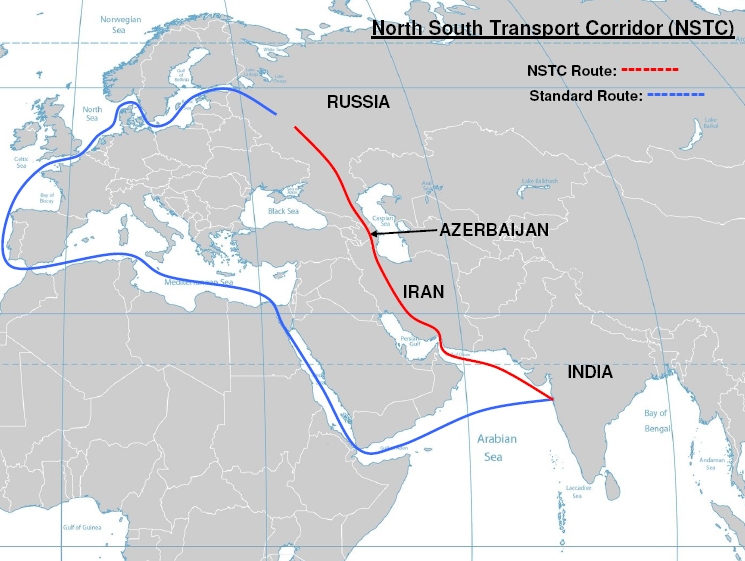
On a map, the Eurasian project reads less as a bloc than as a series of corridors. The North-South corridor, linking Russia to Iran and then India via the Caspian Sea and Gulf ports, holds a particular place. The Eurasian Economic Commission reports that 11.9 million tonnes of freight were transported by rail on this corridor in 2024, with the objective of raising the eastern branch capacity to 15 million tonnes by 2027 and 20 million by 2030.
This corridor answers a practical necessity. European routes are more constrained, Baltic ports less central for certain Russian flows, and international payments remain subject to increased scrutiny. Accordingly, Moscow is promoting itineraries where partners do not automatically align with Western restrictions: Iran, Azerbaijan, Kazakhstan, Turkmenistan, the Emirates, India. The EEU serves as a regulatory framework to harmonise customs, certificates, technical standards and digital transport documents.
Kazakhstan occupies a delicate position in this architecture. It is an EEU member, a strategic partner of Russia, but also intent on maintaining its ties with the European Union, China, Turkey and the United States. Kazakh authorities have repeatedly stated their intention to comply with Western sanctions where applicable to their own companies, while continuing legal trade with Russia.
Armenia and Kyrgyzstan illustrate another facet of the phenomenon. Since 2022, several Western analyses have noted a rise in commercial flows towards these countries in sensitive categories, followed by an increase in exports towards Russia. Russian and Eurasian authorities present these exchanges as legal regional trade; Western institutions sometimes see potential re-export circuits requiring monitoring.
This grey area is one of the most sensitive points in the file. The term "circumvention" covers very different realities: parallel imports authorised by Moscow, third-country re-exports, supplier substitution, changes in customs nomenclatures, or entirely legal trade in non-sanctioned goods. The EEU does not eliminate this cost; it partially institutionalises it by providing a circulation space where Russian firms retain some room for manoeuvre.
The numbers tell of adaptation, not victory
Russia's foreign trade has not collapsed, but it has contracted and recomposed. According to Russian Federal Customs Service data cited by Interfax, Russian goods exports fell 3.7% in 2025 to $418.3 billion, while imports declined 1.4% to $279 billion. The trade surplus remained substantial at $139.3 billion, but was 8.2% lower than in 2024.
These figures contradict two simplistic readings. The first holds that Western sanctions commercially isolated Russia to the point of blocking its trade — which the data does not support. The second holds that Moscow replaced its former relationship with Europe without loss — which the figures also do not support: Russia maintains a surplus, but depends more heavily on raw materials, discounts to certain buyers, higher logistics costs and a reduced number of major partners.
The Bank of Russia reported that the trade surplus for Q1 2026 had fallen to $25.3 billion, from $30.7 billion in Q1 2025. The institution attributes this decline to stronger growth in imports than exports, even as non-energy exports increased.
The IMF, in its April 2026 forecasts, revised Russia's 2026 growth projection upward to 1.1%, from 0.8% previously, citing higher oil and commodity prices amid Middle Eastern tensions. However, Russian growth had slowed to around 1% in 2025, after stronger expansion in 2024, under the combined effect of restrictive monetary policy, Western sanctions and pressures on the productive apparatus.
In this context, the EEU is less an economic miracle than a shock absorber. It facilitates regional trade, supports certain logistics circuits and allows Moscow to present a strategy of openness towards non-Western partners. But it does not resolve the structural constraints: dependence on hydrocarbons, difficulties accessing certain technologies, public finance pressures and the relative weakness of the domestic markets of the smaller member states.
Moscow, Brussels and Beijing don't read the same balance sheet
In Moscow, the EEU is presented as proof that part of the world continues to trade with Russia on its own terms. In Brussels, Washington or London, the same flows are often analysed through the prism of sanctions effectiveness and re-exports. In Beijing, New Delhi or Ankara, the approach is more transactional: buy energy, sell goods, preserve diplomatic autonomy and avoid excessive exposure to Western secondary measures.
This divergence of interpretation explains why the same figure can serve three different narratives. When Sino-Russian trade still exceeds $220 billion despite its 2025 decline, Moscow sees confirmation of a durable Asian pivot. Western analysts read it as deepening dependence on China. Chinese companies see both an outlet and a risk: the Russian market is open, but it can expose certain banks and suppliers to US or European regulatory pressure.
The Centre for Research on Energy and Clean Air reported in April 2026 that Russian fossil fuel exports remained concentrated on a few major buyers: China for a large share of coal and crude oil, Turkey for petroleum products, and the European Union still present on LNG and certain gas volumes. This concentration limits Russia's negotiating leverage.
"Under the new trade regime, the Indonesian side has opened preferential access to 90% of the product nomenclature."
Andrey Slepnev, Trade Minister of the Eurasian Economic Commission · December 2025For non-Russian EEU members, the equation is more subtle. Kazakhstan, Armenia and Kyrgyzstan benefit from parts of the new trade routes, but do not necessarily wish to be locked into an economic confrontation between Moscow and the West. Their interest lies in capturing flows, attracting investment, retaining access to Western markets and strengthening their own sovereign margins.
This divergence of internal interests prevents treating the EEU as a homogeneous bloc. Russia seeks strategic depth within it. Kazakhstan defends logistical centrality. Armenia finds economic access but diversifies its relationships. Belarus remains the most economically aligned state with Moscow. This diversity gives the Union flexibility, but also limits its capacity to act as a fully coherent alternative to Europe.
An alternative exists, but remains incomplete
In the months ahead, the test will not only bear on summits and declarations. It will bear on three concrete files: the pace of negotiations with India, the operational implementation of agreements with Iran and Indonesia, and the capacity of the North-South corridor to carry sufficient volumes at competitive costs. If these three elements advance, the EEU will gain credibility as an expanded Eurasian platform.
But Russia's ambition meets a fundamental constraint: an economic alternative cannot be decreed. It requires solvent markets, reliable infrastructure, banks capable of settling transactions, insurance, common standards, quality suppliers and sufficient political trust. Europe offered Russia a wealthy, nearby, technologically advanced and institutionally predictable market. Eurasia offers geographical and demographic depth, but more dispersed, more costly to connect and more heterogeneous.
The shift is therefore real, but partial. Russia is not returning to its pre-2022 relationship with Europe. Nor is it pivoting to a fully autonomous system. It is navigating a segmented world economy, where Western sanctions reduce certain access but also create incentives to build alternative circuits. In this landscape, the EEU serves as a hinge: sufficiently institutionalised to organise flows, too narrow to replace the lost markets alone, but useful enough to sustain the narrative of a Russia turned towards Eurasia.
The risk for Moscow is transforming an announced diversification into a new dependence. If China becomes too dominant, if India remains primarily an energy buyer, if Iran and Indonesia do not produce the expected volumes, the EEU will remain more of a regional safety net than a genuine strategic substitute. The decisive question will be posed less in summit halls than in Iranian ports, Kazakh border posts, Indian banks and Russian freight stations.
Timeline — four weeks that set the framework
28 April 2026 — Beijing clarifies the preferential tariff regime for African countries between 1 May 2026 and 30 April 2028.
1 May 2026 — China's zero-tariff regime enters force for 53 African countries; first batch of South African apples cleared at Shenzhen.
10 May 2026 — Vladimir Putin describes Russia-China coordination as a factor of international stability.
14 May 2026 — BRICS foreign ministers meet in New Delhi amid international tensions.
16 May 2026 — TASS reports Ghanaian President John Mahama will attend the Russia-Africa summit in Moscow in October.
18 May 2026 — The Kremlin declares strong expectations for Vladimir Putin's visit to China.
20 May 2026 — Xi Jinping and Vladimir Putin sign a joint declaration in Beijing and extend the Russo-Chinese Treaty of Good-Neighbourliness.
29 May 2026 — Supreme Eurasian Economic Council summit in Astana; Putin announces intensification of EEU-India trade negotiations.
Sources
- Eurasian Economic Commission — EEU trade data 2025, Indonesia agreement (Dec. 2025), North-South corridor (Sept. 2025) — eec.eaeunion.org
- Interfax — EEU mutual trade 2025, Russian exports 2025 — interfax.com
- Reuters — EEU-Iran free trade agreement (May 2025), Sino-Russian trade 2025, IMF forecast (Apr. 2026)
- Associated Press — Russia-India summit (Dec. 2025)
- Eurostat — EU-Russia trade Q1 2022 – Q4 2025 — ec.europa.eu
- Bank of Russia — balance of payments Q1 2026 (May 2026) — cbr.ru
- TASS — Lavrov, Russia-Africa trade (Dec. 2025); Russia-Africa summit (Apr. 2026)
- Centre for Research on Energy and Clean Air — Russian fossil fuel exports (Apr. 2026) — energyandcleanair.org
- TAdviser — Russian foreign trade 2025 — tadviser.com